Navi Mumbai Medical Breakthrough: 60-Year-Old Ahilyanagar Farmer Regains Near-Normal Vision Through AI-Assisted Surgery
· Free Press Journal
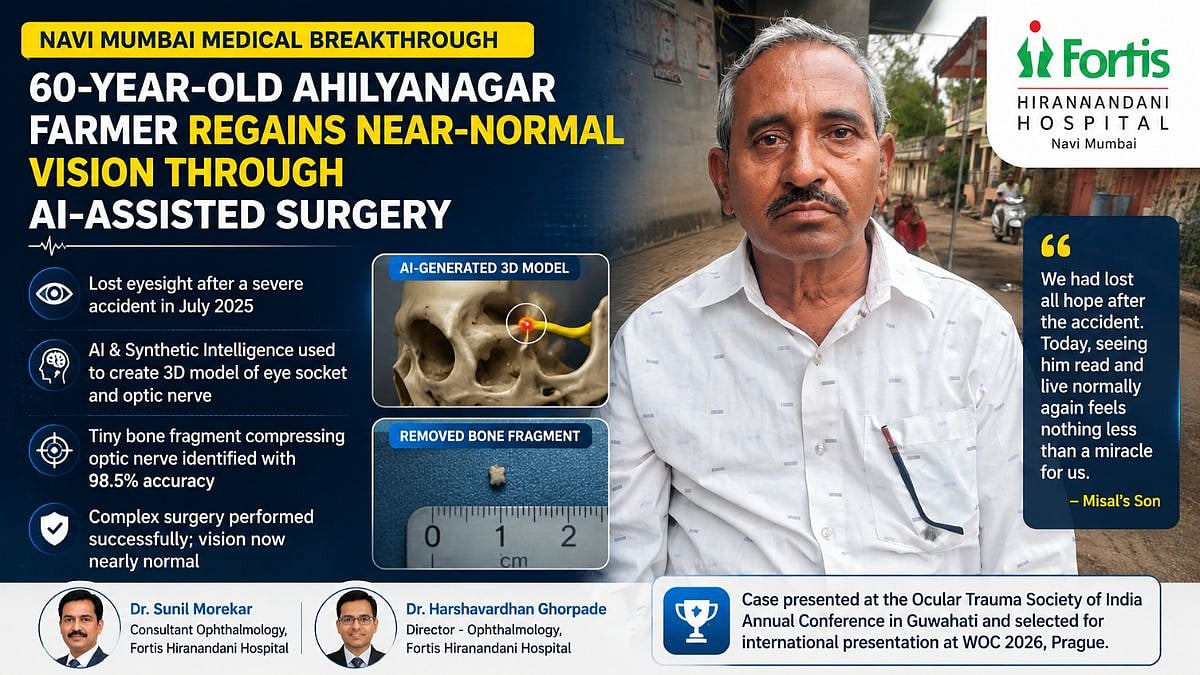
Navi Mumbai, June 24: A 60-year-old farmer from Ahilyanagar, Ramkrishna Misal, who had completely lost his eyesight following a severe accident in July 2025, has regained near-normal vision after doctors at a Navi Mumbai hospital used Artificial Intelligence (AI) and Synthetic Intelligence-based technology to create a highly detailed three-dimensional reconstruction of his eye socket and optic nerve pathway, enabling them to identify and remove a tiny bone fragment compressing the optic nerve.
Visit casino-promo.biz for more information.
Misal had remained blind for several months after surviving the accident and spending 38 days in a coma. Despite undergoing multiple CT and MRI scans and consulting specialists in Mumbai and Pune, the exact cause of his vision loss remained undetected, with doctors informing the family that the chances of recovery were extremely low.
After being referred to Fortis Hiranandani Hospital for advanced neuro-ophthalmic evaluation, ophthalmologists Dr. Sunil Morekar and Dr. Harshavardhan Ghorpade re-examined previous scans and clinical findings.
Advanced eye testing, including Optical Coherence Tomography (OCT) and retinal imaging, revealed swelling of the optic nerve without evidence of optic atrophy, suggesting that vision recovery could still be possible.
Advanced Technology Reveals Cause
“The key clue was that the optic nerve had not become pale, which usually indicates permanent damage. The presence of some light perception suggested that the nerve was still functioning, and that there was a possibility of recovery with the right intervention,” said Dr. Sunil Morekar, Consultant Ophthalmology, Fortis Hiranandani Hospital.
The doctors suspected a hidden cause — tiny bony fragments compressing the optic nerve near the orbital apex, an area often missed on routine imaging.
“These small bony fragments are often not seen on standard scans because they are very small and may lie along the exact course of the optic nerve, which requires highly detailed imaging to detect,” Dr. Morekar explained.
To pinpoint the exact problem, the medical team used Artificial Intelligence along with Synthetic Intelligence technology to generate a detailed 3D model of the orbit and optic nerve region from available scan data.
“We used Synthetic Intelligence to generate a 3D model of the orbit. It identified a very small bony fragment compressing the optic nerve. During surgery, we found the bone exactly at the predicted location with about 98.5% accuracy,” Dr. Morekar said.
Complex Surgery Restores Vision
Based on the findings, doctors performed a highly complex optic nerve decompression surgery and removed the bone fragment. The procedure involved operating in a narrow space surrounded by critical nerves and blood vessels, where even a minor injury could have resulted in permanent vision loss.
“This was a highly complex microsurgery because we were working in a very tight space where multiple critical structures are present. The bone fragment was only around 2 mm, and after several months, tissues become stiffer and more difficult to separate safely,” said Dr. Harshavardhan Ghorpade, Director - Ophthalmology, Fortis Hiranandani Hospital.
“In delayed traumatic optic nerve compression cases, vision recovery is extremely rare. However, in this case, the absence of optic atrophy and precise SI-based localisation gave us confidence to proceed with surgery,” he added.
Misal showed early signs of visual improvement within a day of the surgery, with his vision continuing to improve steadily over the following weeks. Over the next six to seven months, his eyesight improved significantly and is now nearly normal, allowing him to read, use a mobile phone and perform daily activities independently.
Case Gains International Recognition
At a recent follow-up visit, doctors confirmed sustained improvement and stable recovery of visual function. The case has been presented at the Ocular Trauma Society of India Annual Conference in Guwahati and has been selected for international presentation at the World Congress of Ophthalmology in Prague in June 2026.
Also Watch:
Mumbai Doctors Remove Rare 6-7 Cm Tumour Spreading From 19-Year-Old's Nasal Cavity To Brain In Complex 7-Hour Surgery“This case shows that even when patients are told nothing can be done, detailed reassessment and advanced technologies can sometimes identify treatable causes and change outcomes completely,” Dr. Ghorpade said.
“We had lost all hope after the accident. Today, seeing him read and live normally again feels nothing less than a miracle for us,” said Misal's son.
To get details on exclusive and budget-friendly property deals in Mumbai & surrounding regions, do visit: https://budgetproperties.in/