'People Sleeping On Pavements Cannot Be Blamed If Vehicles Run Them Over': Delhi HC Enhances Compensation
· Free Press Journal
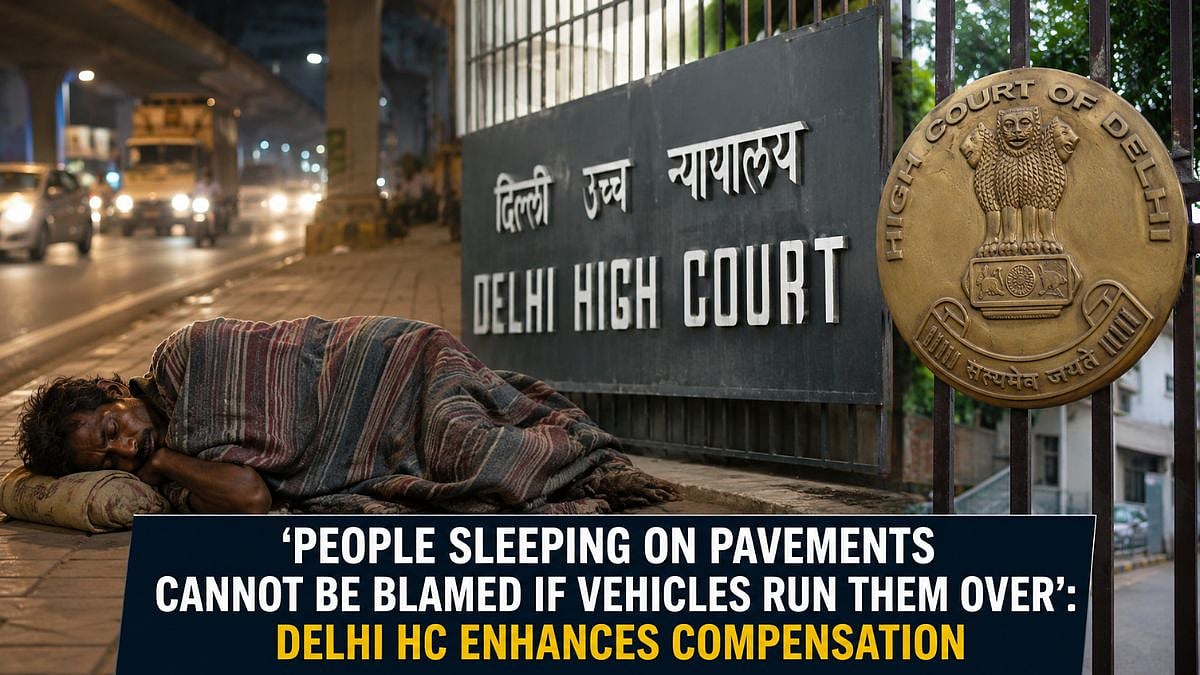
New Delhi, July 25, 2026: The Delhi High Court has ruled that people sleeping on pavements cannot be held responsible for road accidents if they are hit by vehicles.
Visit extonnews.click for more information.
The Court observed that homeless people and workers who sleep on pavements do so because they have no other safe place to rest and cannot be expected to anticipate that a vehicle would drive onto a footpath.
Safety On Footpaths
Justice Anish Dayal made the observation while hearing appeals against a Motor Accident Claims Tribunal (MACT) order that had reduced compensation by 50 per cent on the ground of contributory negligence.
The case arose from a 2015 accident in which a truck ran over four people sleeping on a pavement beneath the Madipur Metro station, killing two and injuring two others, Bar & Bench reports.
The High Court said it was surprised by the tribunal's conclusion that the victims were partly responsible for the accident. Instead, it said the real question should have been whether the truck driver had any authority to drive onto a pavement, a space reserved exclusively for pedestrians.
The Court answered that question firmly in the negative, observing that whatever activity is taking place on a pavement, whether people are walking, sleeping, or hawkers are present, it cannot amount to contributory negligence when a motor vehicle enters that space. In a strong message on pedestrian safety, the Court made it clear that responsibility rests entirely with the driver who violates the law by driving onto a footpath.
Protection For Homeless People
Justice Dayal acknowledged the reality that many people in India are homeless, work night shifts, or are labourers at construction sites with no place to sleep. For such people, pavements often become the safest available place to rest.
The Court observed that while sleeping on a pavement may involve a calculated risk, that cannot be interpreted as contributory negligence in the event of a road accident.
Setting aside the MACT's 2017 finding of 50 per cent contributory negligence, the High Court held that a pedestrian who is walking, standing, or resting on a pavement because of compelling circumstances cannot reasonably expect a vehicle to be driven there.
It also stressed that drivers must exercise greater caution near pedestrian areas and cannot use pavements even if they are being used for purposes other than those originally intended.
The Court further noted that the law does not permit pavements to be used for unauthorised encroachments, parking vehicles, or driving motor vehicles. Their primary purpose is to provide pedestrians with a safe space away from vehicular traffic.
Also Watch:
Delhi HC Refuses To Restrain OpenAI, Says ChatGPT Training On ANI Content Not Prima Facie Copyright InfringementCompensation Enhanced
Holding the truck driver solely responsible for the accident, the High Court enhanced the compensation awarded to the victims and the families of the deceased. It directed the insurance company to deposit the revised compensation, along with accrued interest, with the MACT within six weeks.
The judgment was delivered on July 8 in the case Digamber Kumar vs National Insurance Co Ltd & Ors, after four appeals were filed challenging the tribunal's earlier decision.
To get details on exclusive and budget-friendly property deals in Mumbai & surrounding regions, do visit: https://budgetproperties.in/