FPJ 98th Anniversary: How Maharashtra's Heritage Forts Are Being Restored One Stone At A Time
· Free Press Journal
Until 2010, Ghangad, a 17th-century Maratha hill fort 35 kilometres from Lonavala, was more a source of pride than income for Ekole, a sleepy hamlet of 70-odd residents at the fort’s base. Perched atop a sheer basalt outcrop around 160 metres above Ekole, the rugged fort drew fewer than a dozen visitors a month. Only those with technical climbing skills made it past its steep rock face to the summit.
Visit newssport.cv for more information.
That began to change when Milind Kshirsagar, a Pune-based fort enthusiast and founder of the conservation group Shivaji Trails, together with volunteers, installed a ladder to the top, restored the old steps and cleaned the fort’s seven water tanks, spending three years and lakhs of rupees from his own pocket. The busloads of visitors who now converge on Ekole during weekends bring its residents a much-needed addition to their modest earnings from paddy farming.
“Things have always been difficult here. Money isn’t steady and government support is minimal,” says 36-year-old Lahu Kadu, who has spent his entire life in Ekole and doubles as a guide. Other families have taken to selling daily provisions, emergency supplies, home-cooked meals and refreshments to tourists. The extra income from increased tourist footfall, although restricted to certain months and nowhere near enough for a turnaround, has helped Ekole’s residents go from mud-and-thatch houses to brick-and-cement homes. “We are indeed proud of the fort,” says Kadu, “but earning a living obviously comes first.”
Milind Kshirsagar, founder of the conservation group Shivaji TrailsA Poignant Paradox
Ghangad is one of Maharashtra’s more than 350 forts — or over 600 fortified structures when smaller forts and outposts are included, the most in any Indian state by either count — that reflect a poignant reality of fort conservation. Hailed by those who show up but failed by those who should, these silent sentinels of the past stand between passionate citizens who care to the point of devotion, and systems too overwhelmed to measure up. By some estimates, Maharashtra has around 200-250 organisations and citizen groups active in fort conservation.
Founded in 1996, Shivaji Trails was Milind Kshirsagar’s response to the growing need for trained citizen participation in conserving forts. “Every fort is a living classroom with its own lessons in statecraft, military strategy, engineering and human ingenuity,” he says. His fascination with forts has led him on a journey to as many as 950 forts across 17 states over three decades and 1.75 lakh kilometres, all on a two-wheeler with his wife and son, undeterred by nine major accidents and 60 fractures.
While working as a sports teacher, Kshirsagar set up history clubs across schools in Pune and introduced students to fort conservation. Powered by volunteers from these clubs and funded almost entirely from his personal savings, Kshirsagar’s labour of love at Ghangad, Chavand, Tikona and Narayangad demonstrates the potential of citizen participation in arresting the decline of forts. “Passion always outperforms bureaucracy,” he quips.
Durgveer Pratishthan volunteers cleaning up a cistern at SamangadA shared responsibility
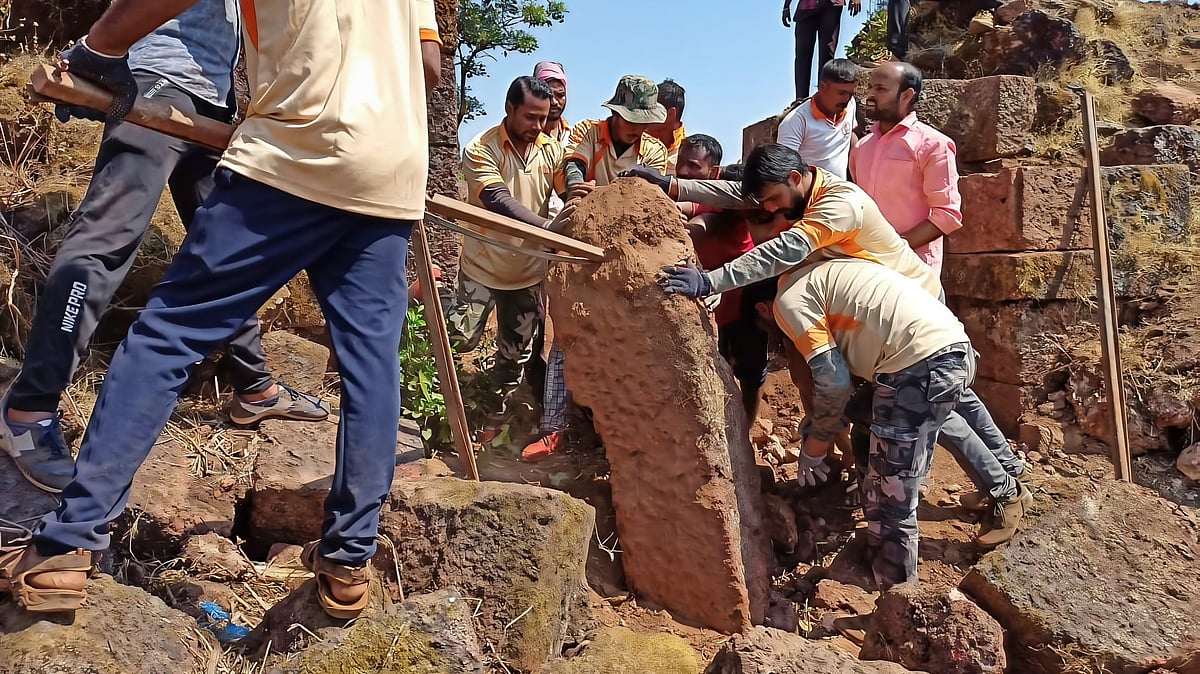
Passion is what also drove Santosh Hasurkar to the cause in 2006, though with a focus on lesser-known forts. “Conserving the most enduring symbols of Maharashtra’s identity is a collective civic responsibility best fulfilled as a people’s movement,” he says. Since its inception in 2010, his organisation, Durgaveer Pratishthan, has taken conservation beyond just repairs. His team of over 1,000 volunteers has worked hard to revive over 100 neglected forts, painstakingly cleaning, restoring and documenting them, creating public awareness through talks and exhibitions, installing critical signage and safety measures, and enabling local communities to improve their lives while reconnecting with the forts.
One such fort is Samangad, built in the eighth century atop a lateritic plateau in present-day Kolhapur district and strengthened in 1676 by Chhatrapati Shivaji. Over time, the fort had become a picture of neglect with dense undergrowth, thorny vegetation and decades of silt, soil and tangled roots engulfing its pathways, historic structures and rock-cut water cisterns, including Saat Kaman Vihir or a seven-arched stepwell considered one of the finest works of medieval engineering.
That was until Hasurkar began a decade-long restoration campaign in 2015 that has seen more than 100 volunteers — through nearly 20,000 hours of shramdaan (voluntary labour) and several lakh rupees in citizen contributions — clear vegetation, remove 300 tractor-loads of silt to revive its cisterns, including the stepwell, and encourage public participation through heritage walks and awareness programmes, bringing the fort back onto the tourist map.
Beyond revival
Improved access, however, comes with a flip side. Veteran mountaineer Umesh Zirpe, president of the Akhil Maharashtra Giryarohak Mahasangh (AMGM), is among those who have closely followed the transformation of Maharashtra’s forts into magnets for mass tourism. “Spurred by social media and looking for nothing more than fun, many people visit forts these days with scant understanding of their terrain and weather, increasing the risk of mishaps,” he says.
Umesh Zirpe, president of the Akhil Maharashtra Giryarohak Mahasangh (AMGM)When the helpline buzzes with distress calls from stranded or missing visitors, volunteers from the AMGM-run Maharashtra Mountaineers Rescue Coordination Centre (MMRCC) are often the first to respond, free of charge, risking their own lives out of a sense of social responsibility. Since 2016, MMRCC volunteers, now more than 350-strong, have rescued over 2,400 stranded visitors and recovered hundreds of bodies.
Experts aver that this voluntary verve far surpasses official stewardship when it comes to forts. Effective revitalisation of forts needs a host of measures: A dedicated autonomous authority with a long-term mandate to bring together archaeologists, historians, ecologists, engineers, tourism experts and local representatives. Archaeology departments with greater funding, staffing, institutional support, political commitment and insulation from political interference. Clearer responsibilities and better coordination among the archaeology, forest, revenue and public works departments with overlapping jurisdictions over the forts. Better visitor amenities such as information centres, drinking water and toilets. Tighter security against theft, vandalism and unauthorised construction. Scientific conservation approaches specific to the historical and structural contexts of individual forts, focused as much on the monuments as on the surrounding landscapes and habitations.
Must-Visit Travel Destinations Of 2026: Forts Of Maratha Warriors To Explore In Maharashtra On The Occasion Of Chhatrapati Shivaji Maharaj JayantiThe way forward
“The original character and setting of forts must be respected in their entirety,” says conservation architect Vikas Dilawari, who restored Mumbai’s Worli Fort with G5A and is currently restoring Mahim Fort. “When forts are treated like any other tourist attraction, beautification begins to dominate conservation and needless interventions creep in. Facilities for visitors do not mean cannons standing next to flowering trees, children’s slides and ornamental parks. Interventions should be minimal and only to the extent necessary for prolonging the life of the structures.”
Insensitive treatment can jeopardise historical authenticity. “Tighter oversight is required, especially when repair works that require patience and precise methods are outsourced,” says Dilawari. “Reconstruction must be backed by strong evidence, detailed studies and interdisciplinary expertise. Heritage is always subtle. It doesn’t need to shout. Its presence should be gracefully felt, acknowledged and enjoyed.”
Meaningful conservation entails proactive stewardship. “We should involve experienced citizen groups and develop best practices for long-term management of forts, while devising ways to make them self-sustaining,” says Kshirsagar. “Well-planned tourism infrastructure, community-run hostels and visitor facilities at the foothills can benefit both local villagers and tourists.”
Getting people there is only part of the solution. “Every fort should have more engaging ways than token signboards to remind visitors of its history,” says Hasurkar. “When involving citizens and experts, conservation must be supported by clear guidelines. With focused training and orientation, gram panchayats, local communities and schools and colleges can become partners in heritage management.”
Government alone cannot make a lasting difference. “Initiatives like ‘Adopt a Fort’ programme and a public fort fund can make it easier for citizens and organisations to contribute money, expertise and long-term stewardship,” says Zirpe. “A trained Durgamitra (fort-friend) volunteer network can support visitor management and safety. Like Harihar Fort, every fort should cap the number of visitors based on scientifically determined carrying capacity. Our forts do not need more state announcements. They need communities with a stake, experts with a voice and governments willing to listen.”
Turning conservation into a shared endeavour might well be the only way to bridge the irony that the ruggedness and remoteness of forts, built with very little by people with far less, are the biggest impediments to their preservation by a more advantaged generation with far greater means.