Donald Trump Really Wants This Golf Course
· The Atlantic
Sign up for Inside the Trump Presidency, a newsletter featuring coverage of the second Trump term.
Donald Trump is treating the championship golf course he wants to build in Washington, D.C., with the gravity of an actual emergency. He has posted on Truth Social about the course at least 15 times in the past few days, including a dozen posts around 1 a.m. this morning. He wrote yesterday that work “is scheduled to begin IMMEDIATELY!” And the Trump administration has brought in a team of senior Justice Department lawyers, including the agency’s third in command, to defend its actions in court. Last week, when Katie Zacharia praised Trump after he fired her as press secretary, a photo she posted contained a blurred-out map on Trump’s desk of what appeared to be the golf site. It is literally at the top of Trump’s pile.
Visit catcross.biz for more information.
A golf-course renovation is probably not the big priority you’d expect from the president just two weeks before the midterm elections, where his party will face voters who are frustrated by high prices and dislike his many vanity projects. But Trump doesn’t seem concerned that he may be risking another Reflecting Pool scandal at a high-stakes moment. On Sunday, he posted design plans for his PGA-worthy golf course. Right before a hearing yesterday, he called the federal judge presiding over a case about the golf course a “crazed lunatic” and claimed that the Interior Department could go ahead with his plan with no approval.
Trump has pushed to glam up the municipal golf course in East Potomac Park near the National Mall for months, insisting in June that work would begin on “one of the Greatest Golf Courses anywhere in the World” on September 1. But starting such a project is more complicated than such a timeline would imply. The entire park is listed on the National Register of Historic Places and would be subject to extensive bureaucratic reviews.
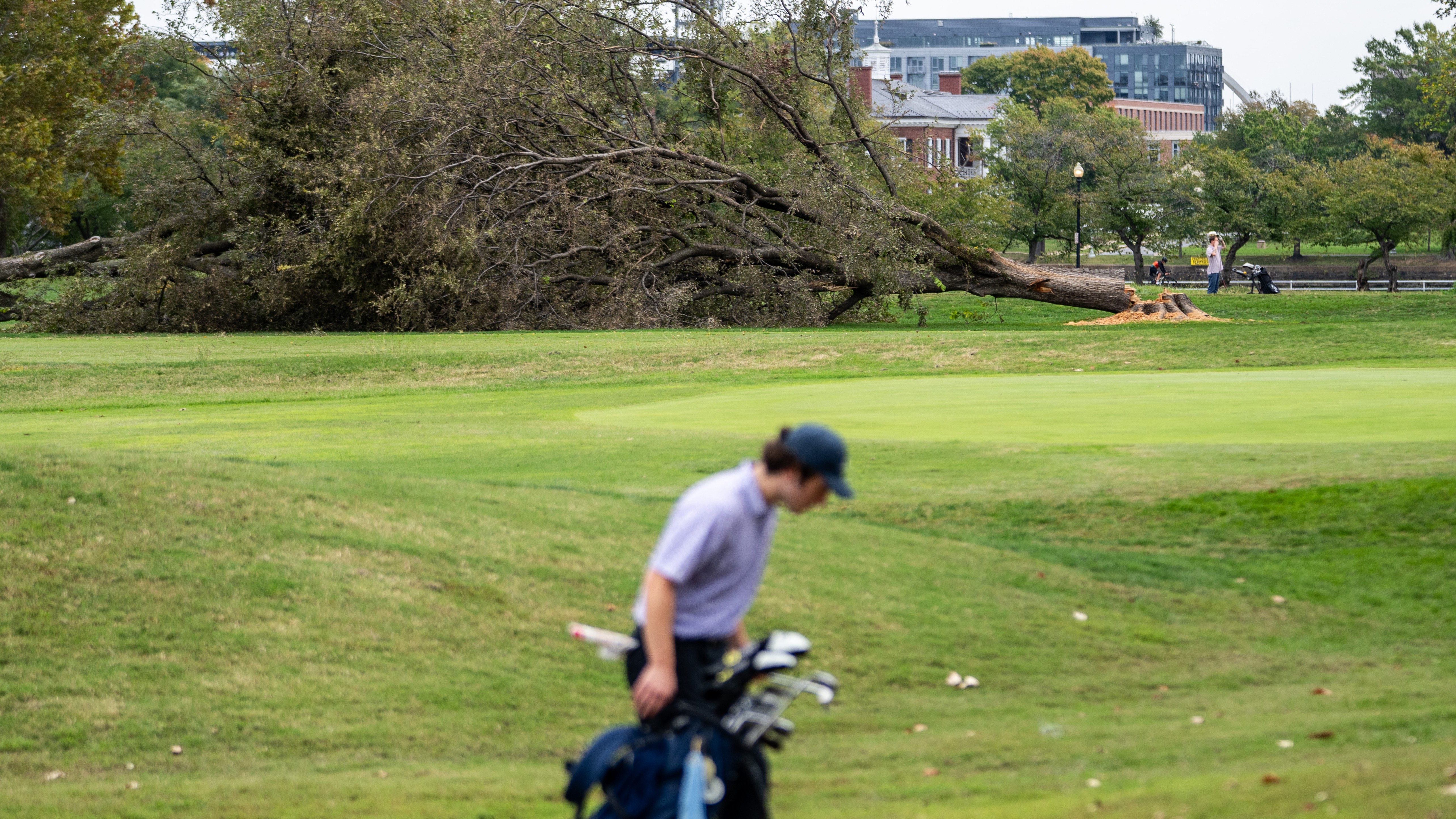
On October 10, the National Park Service, with little notice, cut down more than 400 trees, leaving the timber piled up in the middle of the course and setting off fears among locals that the president planned to blow through the usual red tape and start building. But preservationists and two golfers had sued over the pending changes earlier this year. So it was back to court. There, the government said that the tree removals are part of a 2019 plan to restore the course to its historic state, even though the plan is seven years old and there was no rush before. Ana C. Reyes, the judge in the case, has been skeptical that overgrown vegetation in the park suddenly became urgent enough to necessitate removal over a holiday weekend, especially because it coincided with Trump’s pressure over the course. Reyes insisted yesterday that this could not be a coincidence.
“Both can be true,” a lawyer for the government told Reyes.
“No,” Reyes replied. “Both cannot be true. We’re not dealing with quantum physics here.”
Meanwhile, the design plans that Trump posted have sparked anger among the many locals who use East Potomac Park for recreation. The map appears to remove Ohio Drive, a popular running and cycling route, and to extend the golf course to the man-made island’s perimeter, removing space for picnickers and fishers; it also replaces the park’s three affordable golf courses (one 18-hole and two nine-holes) with a single, pro-level 18-hole course. Even the famous cherry-blossom trees there seem to be at risk of removal. The renovation would significantly shrink who is able to use a place Congress designated in 1897 “to be forever held and used as a park for the recreation and pleasure of the people.”
To get to the bottom of who ordered the tree removals and for what purpose, Reyes called in several Interior and Park Service officials to testify yesterday during a hearing that stretched some seven hours. She wanted to make sense of the contradiction between the government’s position—that this was routine work, not part of any championship-golf-course plan—and Trump’s public statements.
[Read: The cutest target of Trump’s D.C. makeover]
The entire affair has been dizzying. According to Trump’s recent posts, work on the new golf course is ready to begin, the golf architect Tom Fazio has a design, Interior Secretary Doug Burgum is “very excited,” and the park will soon be closed for its big makeover. If you ask the Department of Justice, as Reyes did, Trump’s golf-course plan has not been finalized. There has been no “final agency action,” DOJ lawyers argue, meaning that according to the Administrative Procedure Act, the plan cannot yet be scrutinized in court. Fazio has no contract with the government, they said, and there are not yet official plans to close the park. Still, a DOJ lawyer asserted, when pressed by the judge, that Trump’s statements are not incorrect but can be compared to executive orders that are then interpreted by agencies in ways that are consistent with the law. (On Truth Social, Trump also added that “any variance or changes will be made, depending on site conditions, by the Experts in Parks and Recreation, whose experience and knowledge in Seawalls, Landscaping, and Design are second to none.”)
If this seems confusing, that’s because it is. In a summer hearing for the case, Reyes likened the government’s stance to Schrodinger’s cat. Trump’s golf course is somehow simultaneously being built and not being built. Yesterday’s hearings captured the absurdity of the situation and the acrobatics the government seemingly must perform to defend a president who wants what he wants.
Trump has focused on renovation projects with an unprecedented intensity during his second term, working to put his stamp on the nation’s capital in arch, ballroom, and sculpture-garden form. The golf course is unique, though, in that it deals not with the widely known part of Washington’s monumental landscape but with a space people use in their everyday life.
The government has downplayed its golf-course efforts in court; in a filing on Sunday, DOJ lawyers likened the changes to East Potomac to redesigning “all the art exhibits in a Smithsonian Museum” and claimed that they’re relatively minor. Reyes didn’t buy that in court yesterday. Changing the layout of an entire historic golf course is not like changing exhibits, she said; it’s like tearing down an entire museum and building a new one.
The lawsuit has gotten heated at times. Government lawyers have tried and failed to have Reyes taken off the case, asserting in a court filing that “no reasonable observer could consider Judge Reyes sufficiently impartial to adjudicate this case.” Yesterday, she appeared especially careful, sustaining a number of objections from the government to her questions. After a more pointed exchange, she insisted that a government lawyer tell her whether she was yelling. The lawyer said that the question would be very difficult to answer.
Foreshadowing the government’s arguments, White House Deputy Chief of Staff Stephen Miller wrote on X last week that “I missed the part of the Constitutional Convention that put federal judges in charge of golf-course maintenance.” (Reyes had not actually barred routine work on the course; rather, she’d requested notice of “major developments.”)
As the hearing wound down, Reyes noted that during the final break, she had received worried texts from her mother and brother about reported death threats against her. Then she, like Miller, invoked the early days of the republic. A federal judge receiving threats over a golf course, she said, is probably not what the Founding Fathers envisioned.