Dolores Huerta Taught a Generation How to Organize
· Jacobin
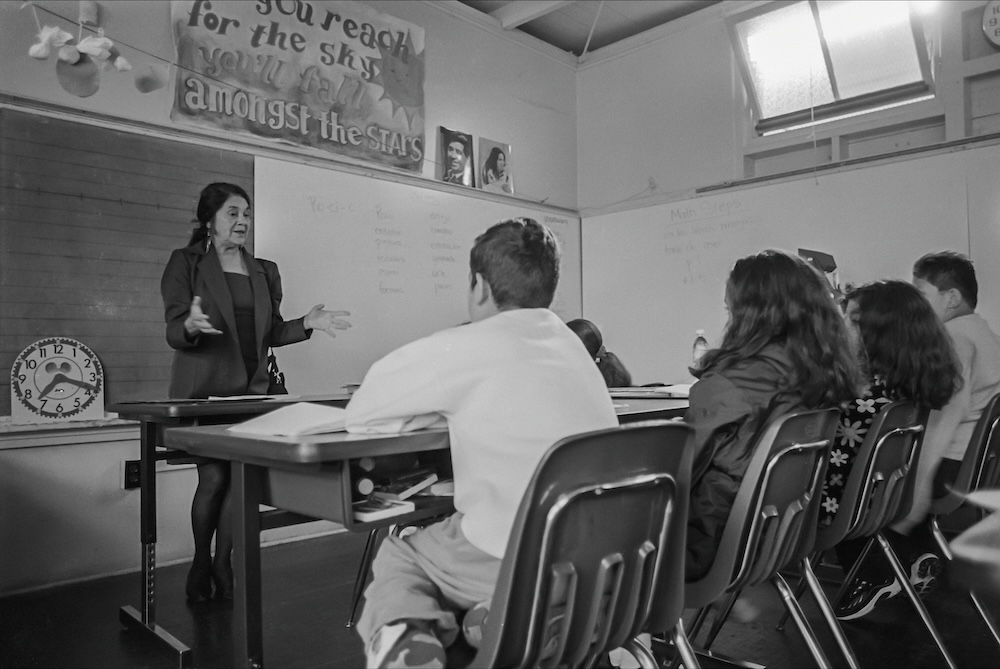
When I came back from a solidarity work brigade in Cuba in the 1970s, I landed in New York City with no place to sleep. I called Lori Huerta, a friend from California, and daughter of Dolores Huerta (1930–2026), cofounder of the United Farm Workers (UFW). Not only did I get space on the floor of the NYC grape boycott headquarters, but Dolores and her partner, Richard, César Chávez’s brother, took us out to eat. Over pizza I enthused about the island. I had stars in my eyes, for both Cuba and Dolores, and still do. I went to work for the UFW as an organizer a few months later.At the beginning of the Iraq War, Huerta marches with actor Danny Glover and an enormous crowd demanding that the troops be brought home. (Courtesy David Bacon)Over the years, long after I had left the UFW and worked for other unions and then as a photojournalist, I would see Dolores again and again. Going to Watsonville to cover the organizing drives of strawberry workers or to Salinas for the strikes in the vegetable fields, I knew she’d be there. It was a profound experience to watch her in union contract negotiations — this diminutive woman facing off against the beefy growers across the table — and see the sense of power it gave workers. For Dolores and Eliseo Medina, another of my teachers, being a good organizer was the bottom line — doing what the workers needed.María Elena Durazo, who came from a farmworker family to head the Los Angeles Labor Federation and now sits in the legislature, remembered, “In that world of rural California, it was the grape strike and the boycotts that taught us that the only way to end poverty and injustice was to organize together. It was the United Farm Workers who taught us that, and Dolores was the best teacher among many good ones.”Returning from Iraq, where I photographed workers after the 2003 US invasion, I took her picture in the front line of marchers against the war. When we were in Sacramento trying to stop the anti-immigrant, anti–affirmative action, anti-bilingual initiatives, she was the first to speak out.There was often tension in the UFW about radical politics, and being called a “red” was sometimes the route out the door. Fear of saying anything that could lead to getting fired enabled César Chávez to exert such power that even otherwise aggressive and militant organizers and workers, like Dolores, didn’t challenge him, whether about sexual abuse or political purges. Abuse is a fact in other unions I’ve belonged to, and progressive leaders have stayed quiet there too. We have to confront this system of male supremacy directly, and I know she believed this.At the start of the Immigrant Workers Freedom Ride in San Francisco, Huerta and hotel workers marched to demand immigrant reform. (Courtesy David Bacon)Her relationship with the Democratic Party was complicated. She supported some movements for political independence in the 1990s while also campaigning for mainstream Democrats. As the union’s political director, she got the California legislature to pass a union recognition bill far better than the National Labor Relations Act, as well as pesticide protections and overtime that don’t even exist in other states. Randy Villegas, our hope for breaking the MAGA stranglehold on the southern San Joaquin Valley, is someone she’s had her eye on for years. You could call her a realist.Four years ago I walked with Dolores from Poplar to Delano, California, in honor of Larry Itliong, who started the 1965 grape strike and boycott there. She was ninety-one then, and I had a hard time keeping up. She sent me a note afterward that ended, “Sí Se Puede con El Rojo Tocino.” It was a beautiful joke.Huerta marches with San Joaquin Valley farmworkers and activists, celebrating the birthday of Larry Itliong, the Filipino leader who started the 1965 grape strike. (Courtesy David Bacon)“Sí Se Puede” are three words we all use now, but she invented this confident way of saying “Yes We Can!” “Tocino” was the nickname the union gave me in the years I worked as an organizer — it means “bacon,” my last name. And calling me “El Rojo,” or “The Red,” in this way honored my politics.So when she called me El Rojo Tocino, I thought, “What a compliment!” I hope I live up to it.This article originally appeared in Jacobin, a democratic socialist magazine publishing long-form essays and analysis on politics, economics, and culture. Subscribe to the print edition for $20 a year.
Visit rouesnews.click for more information.