Is the Populist Moment Over?
· The Atlantic
Subscribe here: Apple Podcasts | Spotify | YouTube
Throughout history, a familiar pattern has shown itself: Political elites lose touch with the people over whom they rule, and those people rebel in one way or another. But eventually a new kind of elite asserts itself. The rise of Donald Trump as a political force more than a decade ago was part of one such global wave of anti-elite sentiment. If the midterm results signal the end of the Trump era, do they also signal the beginning of the end of our populist moment?
Visit turconews.click for more information.
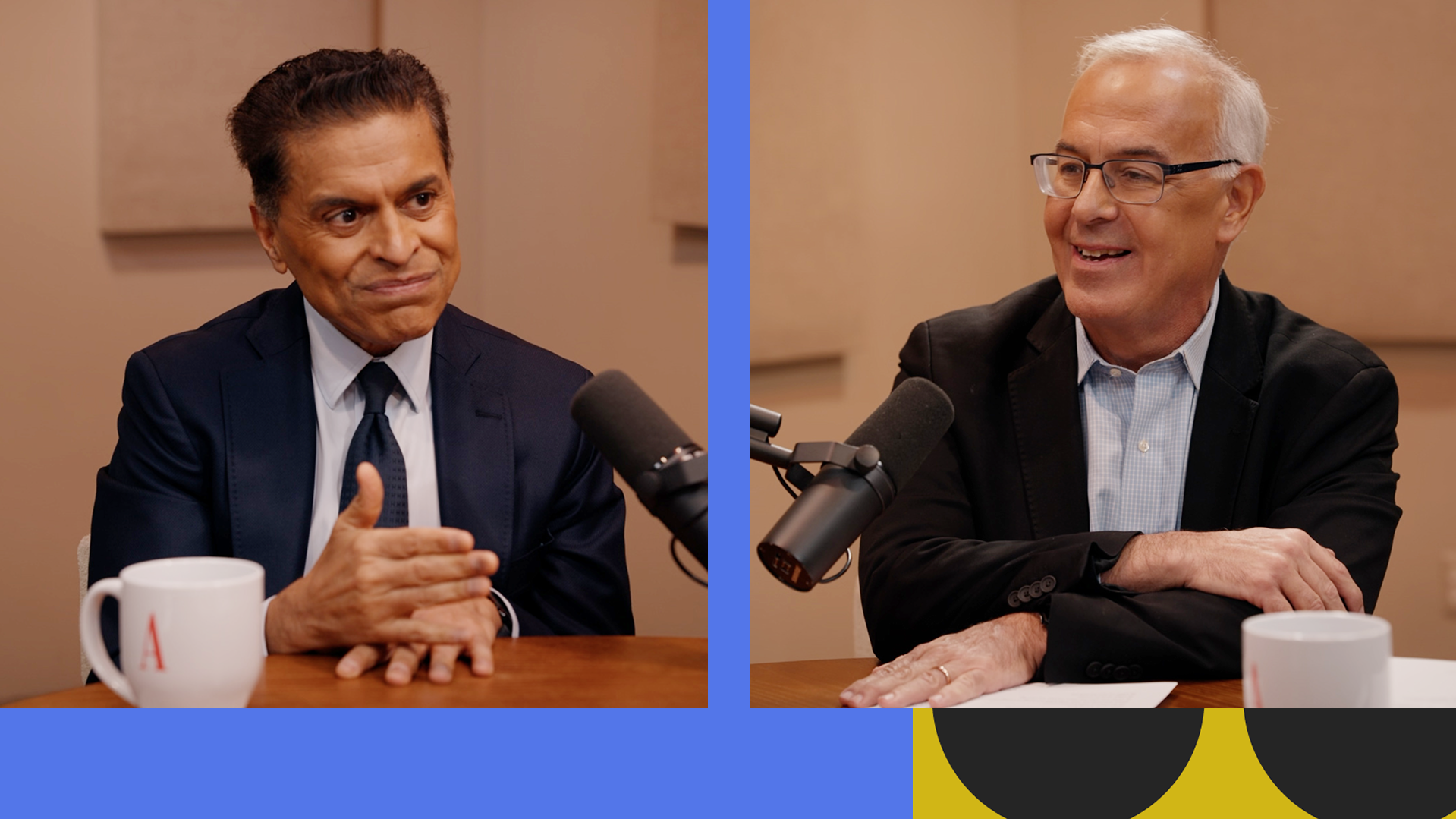
In this episode of The Permanent Questions, Fareed Zakaria joins David Brooks to discuss the history of liberal democracy and the inevitable reactions against it, why technology makes this reaction different from others, and the ways in which our liberal elite will have to change if they want to own the future.
The following is a transcript of the episode:
David Brooks: Today on The Permanent Questions we’re going to talk about a permanent problem. It is that great nations fall when elites get too distanced from the masses and lose popular legitimacy. Here are some examples: The Roman empire in the fifth century, the French monarchy in the 18th century, the Russian aristocracy in the early 20th century, and the shah’s Iran in 1979. There is increasing economic inequality. There’s increasing social inequality.
The elites have grown insular and condescending toward the people. They become self-indulgent and corrupt. The elites break the social contract with the people, and the people withdraw their trust and any sense of legitimacy.
It seems to me that the United States and many other societies around the globe have been flirting with this kind of catastrophe for many decades. Millions of people have lost faith in the elites, in institutions, in the future, and in each other. These losses of faith produce populist backlashes, and that’s what we’ve been living through over the past 15 years or so.
Populist leaders have arisen in societies across the world. Nations on nearly every continent have their own version of Donald Trump. But it turns out that the populists can be guilty of all the sins people associate with the old elite. In fact, they can be more corrupt, more incompetent, more morally bankrupt, more out of touch than the people they promised to replace.
When that happens, the voters want to throw the populace out too, and I believe that’s what happened in the American election of 2026. So the million-dollar questions become: What comes next? Can leaders in either party reform themselves and win back the trust of the people? Can we restore the kind of popular legitimacy that any nation needs to function okay? Most immediately, are we past peak populism? Have the winds shifted so much that a new historical era is possible? And if so, what’s it going to look like?
I’ve asked Fareed Zakaria to join as we wrestle with these questions. Fareed is the host of Fareed Zakaria GPS, CNN’s global-affairs show. He writes a weekly column in The Washington Post. He’s the author of many celebrated and influential books, including The Future of Freedom, The Post-American World, In Defense of a Liberal Education, and most recently, Age of Revolutions: Progress and Backlash From 1600 to the Present.
He’s one of the most profound thinkers in the world today, and so I’m pleased to welcome Fareed Zakaria to this table.
Fareed Zakaria: Such a pleasure, David.
Brooks: Yes, I’m sure it’s the honor of your life.
Zakaria: Honestly, to have a conversation with you is a pleasure and an honor.
Brooks: You can call me anytime.
So one of the things I loved about your most recent book, The Age of Revolutions, is that you describe how liberal societies were built in the first place. Some of your examples are the Netherlands and their golden age, the British golden age, America, and some of the others. I thought that might be useful as we think about where we are as liberal societies, and especially where we are in this moment of, I think, rebuilding. Hopefully, an upcoming moment of rebuilding.
My point of view, as you know, is that this election was so big that we could say, maybe not globally, but in the U.S. at least, not only is Trumpism over, but we’ve passed peak populism.
That’s a bit of an optimistic assumption. Now, you have a more global perspective than I do. Do you agree with that?
Zakaria: So I think in every way—if you look in the book, every one of these liberal experiments, you tend to see a backlash.
At some point people say, “This is too much change. We’re moving too far away from the traditions, the mooring, the community, the old faith of our fathers.” And you get a backlash. Then the question becomes how society handles that backlash. Does it find a way to rebuild, as you say, or does it end up getting mired in a certain kind of dysfunction? The French Revolution being the best example of it not working out.
I think where we are is still in that backlash to 30 or 40 years of globalization, massive economic and technological change, enormous cultural change—the rise of women, the rise of minorities, immigration being the kind of symbolic aspect of that change.
But I do think you’re right that in America we have now seen something interesting, which is Trump 2.0 was a much more pure implementation of right-wing populism than Trump 1.0. People forget that in the first Trump term, there was a lot of Paul Ryan and Steve Mnuchin and a lot of the old kind of Republican Party still at work. Trump 2 was all populism, and it (a) didn’t work—manufacturing employment is not back in America—and (b) the public didn’t like it.
So there is a kind of sense that: Okay, these guys might have been pointing to a problem that was real, but they don’t have the solution. Now, where that goes, I’m not as certain as you—and I know you’re saying it with optimism—because the ball is in the Democrats’ court. Can they craft a new vision that isn’t just taking advantage of this rejection? If they can’t, I do think there’s still enough life in the idea that we have to reject these open borders, open trade; we gotta look out for the working class.
Populism at some level, particularly right-wing populism, is a kind of politics of nostalgia. It’s saying, “I know the world has been changing so much. I’m going to take you back. I’m going to take you back to when it was all more comfortable.” And that’s still a very powerful appeal.
We still pine for the Garden of Eden. And there are all these politicians, whether it’s in Brexit, whether it’s Marine Le Pen in France, who are promising that. What we have had in America—the big good fortune, if you think of it that way—is that we had a very pure attempt to implement these ideas, and it didn’t work.
Brooks: I think that’s a good way to phrase it, because it reminds the Democrats Donald Trump happened for a reason, and they still have to deal with that reason.
But to put my more blindly optimistic spin on things: Whenever I ask people, “What made you who you are?,” it’s always some moment of rupture and repair. Something bad happened; they had to tear down parts of their life, and then they had to rebuild. And I think that’s happened in our personal lives, and I think it happens in national lives.
And now this—I’m a little abashed to be quoting Samuel Huntington to you. Tell me: Let’s make clear who Samuel Huntington was to you. Explain who he was.
Zakaria: So Samuel Huntington was a professor at Harvard, probably the most influential political scientist of the second half of the 20th century.
He wrote incredibly important books in almost every field of political science, comparative politics, American politics, international relations. Most famous for his book The Clash of Civilizations. And he was my academic mentor. He was the chairman of my dissertation committee, but we also had a close personal relationship.
He was an extraordinary guy. Very proper WASP gentleman, and I was this ethnic Indian immigrant, but somehow we got on amazingly well.
Brooks: And now I look back on him with sort of a reverence veering toward awe. Even the books of his I did not like were prescient. So anyway, I bring up Huntington because I think in 1983, when you were probably not yet there, he wrote a book with a very boring title, I think it was called America’s Promise or—
Zakaria: American Politics: The Promise of Disharmony.
That was it. And I’m guessing you’re going to quote the last line.
Brooks:What was the last line?
Zakaria: It’s a great last line. He says, “The critics of America say America is a lie. It is not a lie. It is a disappointment, but it can only be a disappointment because it is [also] a hope.”
Brooks: The part I cottoned onto—I read it in 2020 during COVID; I’m stuck at home. And at some point in that book, he says, I’ve noticed this weird pattern in American history, that every couple generations—I don’t know if it’s 60 years, whatever—America goes through what he calls “a moral convulsion.”
People want to burn everything down. The passionate generation comes on the scene. There’s a new form of communications technology. And those moral convulsions are horrific to live through. And he pointed to the American Revolutionary period 1770s; Andrew Jackson 1830s; the 1890s, when we sort of failed at industrialization and then succeeded. The 1960s—people forget how brutal the ’60s were. There were thousands of bombings.
And he says, I don’t know if I believe in this pattern, but if it holds, sometime around the second decade of the 21st century, America will go through another moral convulsion.
I’m sitting there in 2020 surrounded by all that, and I’m thinking, Well done, Professor Huntington. And the good news is you come out of them. It’s that process of rupture and repair. And so I believe that we had to learn what Trump, what MAGA had to teach us. But I think Democrats have learned a lot of it—not all of them, and some have learned nothing. But on immigration, I think they’ve learned, on the fact that we were ignoring the working class. And so to me, it would be totally normal that we would go through a historical pivot, because we’ve gone through so many.
Jared Diamond wrote a book about international pivots; I think called Upheaval. So sometimes countries just decline, but as long as countries have vitality, they can come right back, and I think we’re at one of those moments.
Zakaria: I tend to share your optimism about that, and I’ll tell why it is.
Firstly, as an immigrant, I see the vitality, right? I came to this country because of that vitality. It still has it in spades. Just look at the tech sector. But don’t even just look at the tech sector. I’m struck by how Americans—you know, one of the things I always notice about America is we really wash our dirty laundry in public.
We talk every problem through. But that very act is in a sense not just cathartic, but you’re searching for solutions. And the solutions are many and myriad, and the problem is large and centralized, so you don’t see the solutions, but they bubble up from the bottom. And that’s one of the geniuses of America—this bottom-up vitality, often in smaller communities, that then moves up.
And I think we’re beginning to see that because, as you say, we now know some of the problems, but it’s also because centrally America is a country that is the embodiment of Enlightenment liberalism.
And what is Enlightenment liberalism, at the end of the day? It is that human beings should have the autonomy, the choice, the dignity, and the freedom to live the kind of life that gives them the satisfaction, the happiness, the pursuit of happiness that they want, and that’s a very powerful idea.
At the end of the day, that’s what people want. Yeah, they would like community, and yeah, they would like—but they want it if they can choose it. They don’t want it if it’s forced on them. And the problem with so much of the illiberal critique of liberalism is ultimately it becomes coercion, because it’s like: Divorces are bad. Okay, agreed. We should have fewer divorces. Okay, agreed. We should put laws in place that make no-fault divorce harder, right? Traditional marriages are good. Great. We should therefore discourage gays from marrying. Wait, why? In other words, it all turns into: Let me tell you how to live your life.
And to me, Enlightenment liberalism has at its core had that Kantian idea that a human being is an end unto himself, not a means to your larger ideological project. You can’t treat him as a pawn in your grand ideological adventure. And that idea will win out in the end. And so at the end of the day, we are going to be a multicultural democracy in this country. We can’t pretend that minorities don’t exist. We can’t pretend that women haven’t realized that they deserve to be first-class citizens. And we’re going to have to find a way to make that work.
Brooks: My inner conservative is coming out. So I think the one conservative idea which I think is true is that for liberal institutions which revere choice to work, they have to be based on institutions that are not based on choice.
And I would say your family is sort of not—you didn’t choose what family you were born into. For many people, their faith is not really a matter of choice. Their attachment to their town; it doesn’t feel like a choice. If you’re a Bostonian, you are Boston down to your bones. And I would include your moral order. There has to be a shared moral order that you didn’t choose, that it’s just you share with people around you.
There’s a historian, George Marsden, who says what gave Martin Luther King’s rhetoric such force was his conviction that right and wrong were woven into the fabric of the universe, that segregation was not just wrong in some times and some places; it was eternally wrong. Slavery is eternally wrong.
And I would say the conservative critique of liberalism was, in many cases, they tried to turn covenantal relationships into voluntary transactional relationships, and the most damaging one was the moral order one, where I would say people got too carried away with liberalism—and I’m a liberal, of course—and therefore they weakened that shared sense of moral order. Without that, I can’t trust you, because we don’t agree on what we ought to do. Without that, I don’t even have my own moral philosophy, because most people can’t come up with their own moral philosophy. So what do you think of that conservative critique of liberalism, and that to be liberals we have to preserve those institutions, mostly faith, family, and flag?
Zakaria: I 100 percent agree with the conservative critique that you lose something when you do that. I mean, this really began with Nietzsche. Nietzsche pointed out that at the end of the day, if you say God is dead, you have kind of upended the entire universe on which society rested. Walter Lippmann has this great book in the ’20s he writes called A Preface to Morals, where he says, The central dilemma of modern society is we have lost the certainty that came from faith, family, and community, and we have replaced it with nothing. And I think it remains the central dilemma.
But here’s the problem: In order to say that you have these things that are not voluntary, not chosen, how do you return to them? Are you going to say that you’re going to force people to attend church? Are you going to say that, again, you’re going to force families to stay together when there are unhappy marriages, when women want to get out?
Are you going to make it more difficult for a woman to be able to separate from a husband and live decently? Those were the mechanisms we used. They were all coercive. They were all ones where you denied the individuality and the dignity of people.
At the end of the day, people want the autonomy and dignity and freedom as individuals. You can try to persuade them that they should try to think about community and family and faith more. You can tell them: Here’s a way to think about what religion got you, and is there a way to substitute for it with some of the—
And frankly, David, you do a lot of that work in the many of the projects you do, but it’s all persuasion. It’s not coercion, and that I think is great. I think a liberal society should be a place where those things happen. Look, I grew up in a much more conservative society.
The divorce rate in India today is under 2 percent. Now, do not draw from that the conclusion that everybody in India is happily married. Draw from that the conclusion there are a lot of miserable women in India who are not able to break free of very bad marriages. And so when I hear sometimes these paeans to community and things like that, there’s a part of me that feels like: Can I get an oxygen mask somewhere here? Because I know that those communities often came out of repression, hierarchy, conformism.
Brooks: So I offered Huntington; you matched my Huntington and gave me a Lippmann. So I’m going to quote Lippmann back to you. Then I want to get back to my optimism. So Lippmann writes another book called The Public Philosophy, which I think must have been the ’50s and ’60s.
And he’s talking about the loss of the moral order that George Marsden had been talking about, and he says, “If what is right and wrong is based on what each individual feels, we are outside the bounds of civilization.” And so my view is of course you can’t force anybody to believe something. You can’t force anybody to get married. But a society can have scripts, and when I went to high school, it was just in my script, in my family, and frankly in my social class: You go to college.
And then it was a script: You get married. Or even in high school, there was a script for if you wanted to date somebody—there was a script. And I think a lot of those scripts are gone right now, and I’m not going to force anybody, but I would love to see more scripts.
Zakaria: Part of what makes that harder, I think, is that we have entered into a world in which because of technology, there is the possibility of kind of radical individualism. So the world you and I grew up in, there was a common culture, and that common culture produced, I think, in its own way, almost subconsciously a common script, a common moral order, and things like that.
And it wasn’t so much religious. I think of it even in terms of the movies we watched, you know? When we were growing up and we were in college—I don’t know, everybody saw the Indiana Jones movies. Everybody saw When Harry Met Sally. Everybody read The Bonfire of the Vanities.
There is no such common culture anymore, because everything is sliced and diced. If you have three kids and they vary in age by three or four years each, they will each have found their own little silo of culture, and it’s very hard to talk about common values when everybody is choosing their own thing, and then that is reinforced over and over again. Technology enabled a kind of radical fragmentation of culture and values and morality. And I think that sometimes we underplay the degree to which technology has fractured us as a society. We look at lots of other things, but if it’s technology, how do you un-invent social media and the internet and the thousand channels people can watch?
Brooks: You may be right that’s never coming back, but that presents a bigger challenge for those of us who are trying to rebuild a liberal era, which is the challenge of: How do you rebuild liberalism in these circumstances to make it humane? And that strikes me as a very big and very daunting challenge.
But to go back to my optimism, I think it’s upon us right now—and one of the things that’s weird about history: There are certain movements; there are tides. Weirdly, you wouldn’t think there’d be global tides of history.
We’re a big, diverse world. But there are certain moments where a lot of similar things happened in a lot of different countries all at once. And so I would say in the early 20th century, we had a totalitarian tide. We had the Russian Revolution, Chinese Revolution, Mussolini, Hitler.
It just suddenly seemed totalitarianism was a thing, and people forget it was admired. Mussolini was admired. There’s that song, I won’t punish you with my version of it, but—
Zakaria: The Cole Porter song ...
Brooks: “You’re the Top.” Mussolini was in that song.
And then in the ’60s, there’s a liberation movement. We need to throw off oppressive systems, and so you get decolonization in Africa. You get the civil-rights movement. You get feminism. You got social liberalization of the Woodstock. And then in the 1980s and 1990s, you get the neoliberal tide.
Not only Thatcher and Reagan, but in his own way, Gorbachev or Deng Xiaoping. They were all neoliberals. And then you had the global populist tide starting in 2010. And so it’s interesting to think in tides.
I feel a little guilty saying the populist tide is over, ’cause if I was sitting in France, in Germany, I may not feel that way. But their populists will screw up in their own time. And so then the question is: What’s the next tide? And I do think some sort of 21st-century liberalism is the best thing we offer, and there’s a suspicion about elites, but to me, you shouldn’t totally look at people’s credentials. You should look at how committed they are to liberalism, and those are the people who will somehow try to figure a way out.
Zakaria: I largely agree with what you said, and I think the way I would put the populist revolution: If you really want to look at it globally, it is a kind of anti-elite revolution.
If you look at places like Turkey with the rise of Erdoğan—you look at India, the rise of Modi—what is striking is these are very different from Western societies. India’s very poor. Turkey’s middle income. It’s Muslim. And yet the common thread is Modi campaigned essentially proudly proclaiming that he was the first man who was going to be prime minister of India who really did not come from an elite background at all, and in fact was very much a man of the people. Now, there were others: Manmohan Singh, the prime minister before him, who actually had been born poorer than Modi. But Modi was right because Manmohan Singh then got a Ph.D., and so he, through kind of social mobility, had moved himself up into the kind of intellectual elite, whereas Modi always said he was a tea seller or his father was a tea seller. I’m not entirely sure that’s true, but he came from very modest background and never got that kind of escalator that elite education gives you.
Erdoğan similarly very much came out of a kind of common person. And almost everywhere you see that there is some kind of a reaction against the rise of this meritocratic, technocratic elite that is increasingly—I mean, you’ve written so well about all of this. These are the bourgeois bohemians.
These are the people who became the credentialed elites. In many ways, the first time I began to think of it this way, and the perpetuation of them as a kind of class, was an article you wrote, or maybe it’s in that book, about how the matrimonial columns of The New York Times, the wedding announcements, were almost a kind of symbol of the mergers of the upper middle class.
Brooks: People literally called it the mergers and acquisitions page. It was Goldman marries, whatever, Skadden Arps. It was Harvard marries Princeton. Phi Beta Kappa marries Phi Beta Kappa, whatever.
Zakaria: Exactly, exactly. You began to realize this is a sociological phenomena. What we should have realized was there’s a whole lot of people who don’t go to Harvard and Yale, and don’t work at Goldman Sachs and Deutsche Bank, and they’re going to look at this world and say, “You guys think this is meritocratic, but we’re somehow shut out of it completely. You guys might think that it’s all happening because you’re so smart, but we exist too.” That’s why Trump said something—and sometimes because he is a political genius, he would say these things unintentionally profound—and he said, “I love the poorly educated.”
And what in a sense he was giving voice to was that roar of protest against a world not only that is being ordered that way, but where people who are successful believe that not only do they deserve their success, but you know what? If you’re in the bottom half, maybe you deserve your lot as well because after all, I just took the test. I wasn’t born rich. Yeah but we lost that maybe Christian universalism of saying, “We’re all God’s children.”
And you got a stroke of good luck and, as you said, at 16 were able to do well on your SATs, and the other person didn’t. And there isn’t a moral distinction between those two people.
So I think that piece feels to me like the most powerful critique that populism has provided to our modern liberal societies, and I don’t know what the solution is, because honestly, you do need talented people to run countries and to run societies and to run corporations and to run universities. Is there fundamentally a different system that doesn’t sort the new elite using brains, education, aptitude, talent?
Brooks: I think about my years in the elite. I was working for William F. Buckley when I was 21, when we first met. I’m part of the establishment. You can’t be a New York Times columnist for 20 years and not be part of the establishment. And so, I want to get to that question of: How do we raise a better leadership class? But when I look back at my own culpability, I think a couple things I got wrong.
First, you had mentioned that mergers and acquisition page, which then became, I think, the first chapter of a book called Bobos in Paradise, which is about the new upper class. And it was about the rise of the educated class.
And I wrote a sentence in that book where I said, Unlike previous establishments, this will not become an insular establishment because anybody can get an education and join. That turned out to be one of the most naive sentences I’ve ever written in my life, because they absolutely turned themselves into an insular establishment you could not crack unless you could afford the SAT prep and all the resources that were poured to the children of the educated class.
That was the one problem. Second, I don’t think I appreciated at the time how insular we were becoming. And then third, and this is the obvious one, is that in 2015, I wrote 500 columns saying, “Don’t worry, Donald Trump will never get the Republican nomination for president.” I was living in D.C., my social life was here in New York, I was traveling to New Haven. How could I be out of touch with America on the quiet car of the Acela? I don’t think I was totally blind to what was happening. I mean, a lot of my writing has been attacking my fellow establishmentarians, but I think those were the mistakes that I made.
Do you think that way? Like, what did I get wrong? What did I not see coming?
Zakaria: Oh, sure. I think probably very similar to yours. I thought he could get the nomination, but I thought he would lose the election because I grew up in India and saw the rise of Hindu fundamentalism, so I had seen this kind of anger and this kind of nationalism and a kind of nationalism that is directed toward the other.
But I agree. I think that being part of this very insular elite, what I lost sight of was how many people in America felt so disconnected from that world, from that elite. I would look at the average statistics, and I would say, “America’s doing so much better than Europe.”
And if you look at the data, it’s really extraordinary that this period that produces populism in America—this kind of right-wing enraged populism, anguish and enraged populism—was a period where the United States outperformed every other advanced economy in the world. The eurozone economy, roughly speaking, and the U.S. economy were the same in 2005.
Today, the U.S. economy’s almost twice the size of the eurozone economy. So we’ve done extraordinarily well, but what I didn’t realize was there had been an enormous inequality, that the average concealed an Appalachia which had really collapsed. And I also did not recognize how much of this is not purely about economics.
It’s about dignity. It’s about a cultural world that has gone away. I went to one of these towns in Pennsylvania once and was talking to people around and trying to understand what was causing this right-wing populism. The answers I got were fascinating, which was essentially it’s not that people lost their jobs; they lost their lives.
Meaning, many of them had found other work, and again, the data shows that unemployment is at a 50-year low right now, roughly speaking. But what happened was in the old days, they had—there was a steel plant. They worked there. But they all worked there, and then they all went to church together, and they all went to the bowling alley together, and they all went to the hardware store. They went to the Kiwanis club together.
Now, much of that is not just about, like, the factory went to South Korea. It’s also that they used to go to the movie theater together, but Netflix took the place of the movies. They’d go to the bowling alley, but online gaming took that.
So it was a combination of technology and globalization, but the result was they had lost their lives. They had lost the community and then that feeling of dignity that came from having a good job and being a member. And I think I just looked at the numbers and was like, Well, per capita GDP keeps going up, and things like that.
And I think a lot of this right-wing populism is at core cultural—a kind of cultural reaction to saying, “My world has collapsed.” The left tends to offer the 10-point Brookings Institution program that says, “Well, we can do a tax credit, and we can give you retraining, and we can ...” And the right says, “I’m going to take you back to before all this happened.”
You know, if you think about “Make America Great Again.” The Brexit slogan was “Take back control.” There is a kind of hearkening to an earlier, more simple time. And it’s very powerfully appealing. I mean, there’s a reason we all have that sense of nostalgia. I remember Nikki Haley once tweeted when she was trying her best to do an impersonation of a MAGA politician, she said, “Wasn’t life so much simpler when we were kids?”
And I think I did the math, and I thought that would’ve been around 1975 for her, and I’m thinking, Okay, the United States had just lost its first war in history, Vietnam. The president had just been impeached for high crimes and misdemeanors. The oil prices quadrupled. And the economy was so bad you had to invent a term—stagflation—to describe high unemployment and high inflation.
Brooks: Crime tripled.
Zakaria: But it’s something fascinating. It’s almost evolutionary that you want to go back. You want to think about a time when it was all better.
Brooks: We’ve admitted some of our sins. Let’s talk about the question you asked, which was: how to build a better leadership class. And my view, which I hope is yours, maybe, is every society has a leadership class.
The idea that you’re going to get away without an elite—that’s not going to happen. Somebody’s gotta run the government, and somebody’s gotta run the big institutions and educational institutions. So I would never want to go back to the establishment of 1950, because you and I would not be sitting at tables like this one.
Zakaria: Exactly.
Brooks: But I think they had a couple of advantages that we could learn from but not replicate. The first is they read Plutarch. Like, how do you create a leadership class that’s going to govern well? This has been a problem thought about for thousands of years. Well, read Plutarch. Read the greats. Read Thucydides. Read Clausewitz. Read Sun Tzu. There are great wisdom literature in how to be a leader and what your responsibilities are. This podcast is an attempt to bring back some of that kind of humanistic learning. The second thing is to tell people, “You’re the elite. You have responsibilities.”
Zakaria: Act like it.
Brooks: Act like it. If FDR was sitting there in—where’d he go? Groton or Choate, one of those schools.
Zakaria: Groton.
Brooks: And his headmaster was telling him that.
Zakaria: Endicott Peabody.
Brooks: Exactly. But today, you go to—I don’t want to single out one school—to an elite institution. It’s like, You’re oppressed; you’re marginalized. You poor Harvard students. So they’re not told that. But then the third thing that they had the advantage of was, at least for some of them, they served in the military.
And so you might have gone to Groton or Choate or Andover, Exeter, and those kinds of schools, but along comes World War I or World War II, and suddenly you’re in the barracks with all of America. And so they did not have the opportunity to become as insular as our elite is becoming, even more insular than the Protestant establishment, which is saying something.
And so to me, when I think of how do you raise a better elite: First, I would hope our institution of education of all varieties would go back and teach what social leadership looks like; second, what social responsibility looks like; but third, would tell the truth—not in the way I’m about to say it, ’cause when I say it it’s laced with a bit of bitterness—which is stop being segregationists.
Higher ed is a segregation system. And you tell people, “We’re blocking social mobility for your kids”; they will flip the tables. And so as a leadership class, there’s a lot of work that needs to be done on us, and I think there’s some dawning recognition that this needs to happen, but I’m not sure.
Zakaria: No, I agree with everything you said. The question becomes: How do you fix it? I remember my first boss. I worked at Foreign Affairs; Jim Hoge, had gone to, I think, Exeter and Yale.
But he then went—
Brooks: Amazingly good-looking guy, by the way.
Zakaria: Yes, yes. There was an Esquire magazine in which he and Robert Redford were both—and it was sort of: What do you do when you’re so good-looking that no one thinks you’re smart? Or something like that.
And I have to confess—
Brooks: Never been my problem.
Zakaria: I thought to myself, I would kill to have that problem. But I think that the point he made to me, which I remember vividly, is he went from there, from Yale, to the Chicago Sun-Times as a cub reporter or an intern, and he said not only was he the only person on the entire news floor who had gone to Yale; there were only about 20 percent of them who had gone to college.
Eighty percent of the reporters. And journalism was a much more mixed enterprise. Now it’s an entirely elite enterprise. It may not be high-paying, but it’s intellectually elite, and that creates a certain conformism and insularity. And I think that one of the challenges has got to be to figure out—I think we still, in the way we do sorting and education, we have not figured out how to find smart poor kids.
Statistically, intelligence is sprinkled roughly equally throughout the entire population.
What that means is we’re not searching hard enough for the smart poor kid who didn’t go through the hoops, who didn’t get that early jump in or didn’t have a great teacher, and maybe that person then needs a little remedial education, or maybe they need to go to summer school.
But we are missing that because we need those people because it’s right; it’s fair; it’s just. But it’s also that energy is a different kind of energy. That drive is a different kind of drive, and I don’t think we’ve figured out how to do it. The other point I want to make about Plutarch is I think here I’m somewhat hopeful for an unusual reason.
I think AI is going to be on almost everything an absolutely revolutionary phenomena, but think about it this way. I think since the Enlightenment, human beings have begun to think of themselves almost entirely as analytic machines. Before that, when we couldn’t understand something, we said, “God did it.”
Why is there day and night? Well, the sun god moves his chariot across the sky, and that’s why you have day and night. And why do we have spring? Well, Persephone, the goddess of spring, wakes up. And then we started to apply our minds and reason and the scientific method to uncover the mysteries of the universe, and it was mind-blowing. We were able to understand all these things that we hadn’t been able to.
AI is now going to take us back to a world where, to uncover the mysteries of the universe, we have to rely on another black box. It’s not called religion; it’s called AI. But the AI will explain things and solve things and do stuff that we just cannot do analytically.
We are no longer the best analytic machine in the universe. And so then the question is: What do we do as human beings? Well, maybe we recover the older qualities of character and temperament and intellect that mattered, which is that we search for wisdom and judgment and courage and leadership and those qualities that inspire people. That’s what they built statues for thousands of years ago. It wasn’t the smartest kid in the class; it was the person who had courage, who could inspire, who did lead.
So maybe, in a strange way, it will bring us back to that because we can’t pretend that we’re just going to be analytic machines because there’s going to be an actual machine that does it better.
Brooks: I would just say the thing that to me matters most is desire and determination, and that if we were awarded that, we would have a much more democratic meritocracy. But the hopeful thing—
Zakaria: And by the way, that’s one of the great things about America, and that gives me great hope because in every rich society, the challenges drive determination because you become rich.
Sometimes when I talk to a bunch of bankers or, you know, rich people, I will sometimes say, “Now let me ask you a question. You guys are all incredibly talented, and you have extraordinary capabilities. But when you look at your children, do you think they have the same drive that you did?”
And usually about 10 percent of the audience will put their hands up. Because at the end of the day, the children are reacting rationally to their circumstances. They’re growing up in enormous wealth, and it’s hard to have that. But immigrants do. And the fact that America still takes more legal immigrants than, for example, all of Europe put together every year, I think that is one of the things that makes sure that the United States remains forward-leaning, optimistic, driven. It has that culture of growth and aspiration because it’s very hard to force it, to tell people, “I know you’re rich, but pretend you’re poor.”
That doesn’t work. You kind of actually have to be from the outside, trying to break in.
Brooks: One of the things I think we agree upon is this is a moment of shaking loose a lot. Even before the midterms, you wrote a column on, and yeah, I’m going to read two sentences from you: “We are living in an age of anxiety, and that means people are unsure about their political allegiances.” Boy, did that turn out to be true.
Everybody’s floating all over the place.
Zakaria: Think about Hispanics moved 20 points in 2024 and then 20 points back in 2026.
Brooks: So suddenly we’re in a period of flux, and not only a period of political flux; I think we’re in a period of moral flux.
I think basically people took a look at MAGA, and they felt some sense of moral shame. I’ve always had a certain idea about America, is that we were vain; we were overconfident; we could be dumb and naive and crass, but we were not malevolent.
And I’ve now thought, Okay, we’ve been malevolent. And so to me that gives us an opportunity really to turn a page and to reinvent the liberalism that you and I both believe in. So the question is: What part of liberalism do you lead?
It’s not only a set of ideas; it’s a way of life. But what is the part that is most needing to be recovered or reemphasized, or something like that?
Zakaria: So to me, the part I think that we have to get right, and we can get right, is we have created a highly unequal society. Partly the machinations of capitalism sometimes do that.
There are some winner-take-all dynamics to, for example, technology industry, where everybody wants to use the same search engine that everybody else uses, so you get this winner-take-all phenomena. But a lot of it is also, frankly, corruption and structural advantages.
Then there’s, of course, the massive inequality in wealth and the taxation system that, for example, taxes capital gains at a much lower rate than income, which probably makes no sense. So if we can fix all of that and create a more genuinely open, fair, level playing field, greater access for people, giving people the ability, in enormously rich countries, to not have to worry about very basic things like health care. I actually think that universal health care would be a very pro-growth policy because one of the things that happens when you have the kind of crazy system we have is people don’t leave their jobs for fear of losing health care.
When I was at Newsweek, I had to do four sets of layoffs, and every person I laid off understood we were in this collapsing market for magazines, and so I didn’t want to do it.
They knew that this was being forced on me, but every single one, every single person I laid off asked me, “Is there any way I can keep my health care for a year or two years because of my kids?” And I think if you made it so that everyone had it—you know, a basic level—I think it would create more entrepreneurship, more people willing to take risks.
If you can fix all that, which I think is possible, you can renew the idea of the promise of a genuinely liberal society, where individuals are treated like individuals and have certain benefits but rights. The question I have for you is: If some of this right-wing populism, if some of this reaction, negative reaction, to a liberal society is cultural, is this sense of, What happened to that world of community and faith and belonging that I believed in?—we can’t just put Humpty Dumpty back together again; we can’t create a white Christian America again, whether or not that was as good or as stable even as people remember—so what do you do?
Brooks: I’m pretty open to some radical left ideas. I don’t know about universal health care because I’m not sure how we make the transition, and I don’t know how we afford it. My radical part on the left would be some sort of basic insurance, so there’s security, whether it’s EITC, or an earned income tax credit, subsidies, some sort of health care. It can’t be crazy the way it is now.
I worry about sapping the spirit of energy the way I believe Europe has. I would adopt some much bigger welfare state, but you gotta give me job growth and economic dynamism. And to me that’s regulations, but also—and this is the thing maybe we can close on, and I don’t know if America will ever believe in this again—but to me one of the greatest things about liberalism is pluralism.
That America, like your family and my family, it was a crossroads nation. We attracted hungry immigrants, and they did great things. And there’s a book by a guy named Sir Peter Hall named [Cities in Civilization], and he looked at the most innovative places in world history, and they were all crossroads nations:
Athens, Florence, Vienna, New York, Silicon Valley. And Hall writes, “People meet, people talk, people listen to each other’s music and each other’s words. They dance each other’s dances and take in each other’s thoughts. Sparks might be struck and something new comes out of the encounter.”
That’s liberalism to me, and America’s so averse to diversity now all of a sudden. Maybe we can’t go back there, but I’ll give you your socialist welfare state if you give me free capitalism and a lot of economic and demographic diversity.
Zakaria: So the challenge then is if you want that diversity—and I entirely agree with you. I mean, you look at any of the great societies in the world—you know, the Netherlands that I talk about in the book—that invented really modern liberalism, modern capitalism, incredibly diverse. They were willing to take in persecuted Protestants. They were willing to take in Jews.
But it does cause people to feel like we are losing our common culture. We are losing our traditions. And that’s in some ways what’s happened here, and to me, that remains the central challenge.
How do you create a society where you celebrate diversity? You encourage it; you want those people; you love the vitality, the spread; you love the kind of enriching and ennobling that takes place with those kind of encounters. But you do create anxiety.
You do create a sense that people feel like, I don’t recognize my country anymore. This world is passing me by. And it’s fascinating that this reaction, this backlash, has been with us as long as liberalism has.
And nobody has come up with an adequate solution to it. Because at the end of the day, the solution that is often tried, which is some kind of coercion or repression, not only doesn’t work, but it so runs counter to the spirit of liberalism. How do you resolve this dilemma?
Brooks: A strong national narrative and strong symbols of America that unite us all. We need bigger White House ballrooms and maybe an arch near Reagan National. Fareed Zakaria, thank you so much for joining us on The Permanent Questions.
Zakaria: David Brooks, such a pleasure.
Brooks: One of the things I appreciate about Fareed is that he is a journalist. He has a weekly show on CNN, so he’s covering the news right up to the date. But as you heard, he has this background with Samuel Huntington, and he’s got a broader historical perspective, which came out especially in that last book, [Age of Revolutions].
And having someone who has a historical perspective on our current moment in one sense was sobering to me because he said we’ve been here before. There are these moments of great diversity, great change. People rebel. You get a backlash. But the problem is not so easy to put it back together. And I think if you were hopefully like, “Oh, we’re just turning the page on MAGA; we’re all going to move forward now,” I think you should not believe that.
But the nice thing about him, which I found exciting, was that he did talk about how big the change is. We can’t go back to the things I’m sort of nostalgic for: some of the moral order, some of the way things used to be, the notion that marriage was sort of a natural thing that most people were going to be aiming for at some point in their life. That’s not all happening. And technology is technology, and AI is AI. And so what we have to do, I guess, as people who want to restore liberal democracies where people get to run their lives and do things like that, is we have to reenvision these systems for an entirely different era.
And I think that’s a project that is not going to just take the removal of Donald Trump and MAGA, but will take a lot of thinking over maybe the next 15, 20 years. And so that’s a new age. But it does reinforce the idea to me that we are past peak populism, that at least in the United States, that era is over, and now we’re in the process of what is struggling to be born.
Thanks so much for joining us at The Permanent Questions with Fareed Zakaria.
The Permanent Questions is produced and edited by The Atlantic in partnership with Yale University. New episodes come out on Sundays. You can watch The Permanent Questions on The Atlantic’s YouTube channel, on Spotify, Apple, or wherever you get your podcasts. If you want to support this work and the work of my colleagues, you can subscribe to the publication at TheAtlantic.com/Listener. See you next week.