Rediscovering Rosa Luxemburg’s History of Ancient Rome
· Jacobin
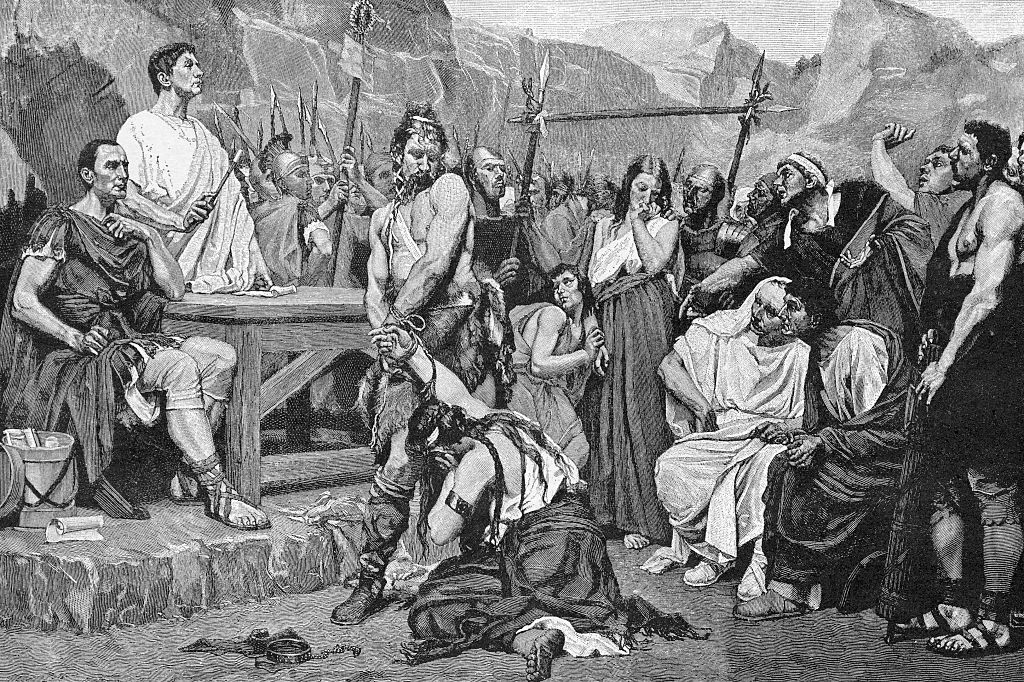
More than a century after her death, Rosa Luxemburg is renowned as a revolutionary socialist and leader of the 1919 Spartacist Uprising in Germany. Her writings have long been a touchstone for socialist theory. But her work as an ancient historian remains almost entirely unknown.Luxemburg’s political writings, especially her work on political economy, were full of historical references, and indeed she often stressed the importance of history to the project of political economy — and revolution itself — in her major works. These references offered a tantalizing glimpse into a rich archive of study on Luxemburg’s part, but there was a frustrating lack of further elaboration on historical topics and the study of history itself.That remained the case until 2001, when Professor Narihiko Ito discovered lost documents in Moscow of Luxemburg’s unpublished lectures and notes. One of the texts discovered is a manuscript on Greek and Roman slavery. This text, titled “Slavery,” survives because it was saved by her former student Rosi Wolfstein and biographer Paul Frölich from being destroyed after her murder in 1919. It was likely to have been a lecture she composed for her courses at the working-class night school in Berlin, where she began teaching in 1907.It has been over a decade since this text was made available in English for the first time in the first volume of Luxemburg’s complete works. However, Luxemburg’s ideas on ancient slavery have not yet received the attention they deserve. We can now see what place the role of Greco-Roman history in general and the Roman slave revolts in particular had in her understanding of Marxist theory.Ancient Roman SlaveryLuxemburg opens “Slavery” by taking issue with the argument of Friedrich Engels that slavery arose in antiquity after the advent of private property. She uses examples from Greek history, and even the Inca empire in Peru, to argue that certain types of exploitation already existed in ancient societies that were communal in nature. She refers to societies of this kind as “the mark community,” a concept she takes from Georg Ludwig von Maurer’s 1854 work Introduction to the History of the Mark, Manor, Village and Town Constitution (which also greatly influenced Engels).In contrast to the early communal forms of social organization, ancient Greece and Rome developed the full alienation of the land from the people, creating a new form of exploitation and slavery. Instead of one society dominating another from the outside by exacting tribute, the dominant actor now incorporated the populations of dominated societies into its own structures and exploited their labor power for trade.For Luxemburg, two further developments arose from this shift. Firstly, trade expands from a purely external practice to an internal one as well. Secondly, “slavery and trade evolved at the same time as the aristocracy,” creating the conditions for a split between a laboring class in the countryside and an intellectual class in the cities.She believed that the Greek city-states had already maximized the cultural potential of this economic system:Greek philosophy, art, and everything that could be achieved on the basis of the slave economy of antiquity had already been perfected by Greece. Rome merely had to borrow it, appropriate it, take possession of it. From then on Rome lived, one could say, as a sponger or freeloader.For Luxemburg, Rome went further than Greece by stigmatizing all forms of labor: “Rome arrived at this conclusion: everything related to work is slave work, physical and mental. In Greece only physical labor had been regarded as slave work.”The high point of slavery in antiquity came during the late Roman Republic and Empire. It was achieved through a combination of Rome’s wars of expansion abroad and the displacement of peasant farmers from their lands at home. As Luxemburg puts it: “In the depths of Roman society radical changes began to take place around the third century BC. It began with Rome’s struggle to establish an empire on a world scale.”The peasant farmers accounted for the majority of Rome’s military forces. This resulted in the collapse of peasant agriculture, as many of these farmer-soldiers lost their lives or went into debt because they could not afford the taxes required to sustain the wars. Without their land, peasant farmers could only offer their labor power to the new, large agricultural estates that the Roman nobility had established, which were called latifundia.This was a precarious position, Luxemburg notes, as there were not enough peasants available to hire for the labor required on the estates, and the peasant farmers themselves could be called back to war at any moment. She identifies the consequences of this labor shortage: “The great proprietors thus had to bring in more slaves. And the wars provided them in great quantities.” This created new antagonisms between citizens and slaves but also led to extreme wealth inequality, as the elite used more slaves to boost their capacity for territorial expansion and production.The Roman Proletariat and the Slave RevoltsWithout a home or gainful employment in agriculture, peasant farmers were forced to move to the cities. Luxemburg refers to this group as the proletariat, quoting the observation of Jean Charles Léonard de Sismondi: “There was in Rome a proletariat as there is today. But whereas the proletariat today supports society, the Roman proletariat lived at the expense of society.”Ultimately, she observes, this social tendency corroded the Roman commonwealth, because the poor free citizen farmers lost their land to the rich and subsequently lived at the expense of the Roman welfare state. Part of this expense was the amount of grain needed to feed Rome’s new urban proletariat. The Roman authorities reduced the cost by moving grain production out of the Italian peninsula and importing the necessary supplies from Africa, Spain, and Sicily instead.Two revolutionary consequences arose from these conditions. First, the Roman proletariat began to demand land redistribution and rallied behind magistrates such as the Gracchi brothers who took up their cause. Second, there was a massive concentration of slaves in agricultural production who would later rise up and revolt. Luxemburg insists that slavery could still be of fundamental importance even if slaves were a minority of the population: “It is not the numbers that are definitive, but the sum total of the tendencies that result from them.”The latifundia intensified agricultural production. As well as changing the way of life for displaced peasant farmers, this also changed the nature of slavery itself, according to Luxemburg:Now of course the living conditions of the slaves had to undergo a change. They were now completely reduced to the status of naked labor power. In agriculture they were labor power that was applied for the purposes of trade. In this entire institution, or configuration, everything worked toward a single purpose: to extract the maximum possible from the slaves.For Luxemburg, “these relations inevitably led to slave revolts, particularly because the slaves had previously been free.” She goes on to list seven slave revolts that took place on the Italian peninsula and in Sicily. The Sicilian revolts are the most famous, in part due to the colorful descriptions that have been passed down from ancient accounts. It is at the bottom of this list that we find the legendary Spartacus, whose name would come to represent Luxemburg and her allies in the German workers’ movement until the time of her death.SpartacusBefore the publication of “Slavery,” we did not know that Rosa Luxemburg had written about ancient history and Rome’s slave revolts, including the historical figure who became the legendary symbol of the Spartacus League. This text demonstrates that before Luxemburg called upon Spartacus to represent her current of revolutionary socialists, she was interested in the place he held within the larger context of ancient Roman slavery and the history of class struggle.At this point in the text, Luxemburg does not offer a dramatic narrative about the life of the Roman slave who Karl Marx once described, in a letter to Engels, as “the most splendid fellow in the whole of ancient history.” Such narratives were widely available in the historical works that we know Luxemburg read and studied.For example, Luxemburg read the famed German historian Theodor Mommsen closely and cites him in her work. Like many historians of his time, Mommsen had a tendency to sympathize with the ruling-class perspective on history. His account of the Spartacus uprising between 73 and 71 BCE depicts its figurehead as a “gang-leader” with an army of “half-savage herdsmen.”Mommsen came up with further colorful epithets for Spartacus and his men as he recounted the crisis they precipitated for the rulers of Rome, referring to them as “banditti” and “robbers.” He accused the rebels of inflicting “atrocities” on “defenseless civilized men,” and attributed their final defeat to internal discord, “lack of a common foe,” and a “barbarous” demand for “plunder.”For Mommsen, the only redeeming quality of Spartacus appears to be the fact that he died the death of a free man at the hands of the Roman General Marcus Licinius Crassus, whom Mommsen calls one of “the great capitalists” of Rome. The differences between Luxemburg’s account and that of Mommsen could hardly be starker.In “Slavery,” Luxemburg deals with Spartacus matter-of-factly as the final representative of the great slave revolts of ancient Roman history. She refers to “the third Sicilian slave revolt, led by the famous Spartacus” within the broader landscape of all the documented revolts in ancient Rome, with an assessment of why they happened and why they failed.In this way, Luxemburg follows the example set by Marx, who put heroic narrative and literary detail aside when seeking to understand and explain ancient history. The ancient Spartacus uprising was born from a sequence of uprisings that came before it: “The slave revolts were the first immense, world-historical class struggles against the exploiters. Not the free peasants, not the proletarians in Rome.” However, they did not lead to a transformation of Roman society:The slaves wanted to return to their homelands; they wanted to break loose and get away from society entirely. They were only partly successful, to the extent that they escaped, some to their homelands, some joining robber bands or becoming pirates. The slave revolts remained without consequence, because any further development of them was not based on any trend of economic development.She presents internal decay resulting from the economic logic of slavery as the main factor behind the eventual demise of the Roman Empire rather than external pressure from invading forces: “It was not only the Germans who brought about the destruction. Rome was already ripe prey for foreign conquest after such consequences had been arrived at as a result of its own development.”In her own time, Luxemburg believed that the modern proletarian revolution would succeed where the great slave revolutions of Rome had failed. In the Introduction to Political Economy, she says:In the end, this great proletariat in ancient Rome was simply maintained by the state. Capitalist commodity production, accordingly, is the first economic form in the history of humanity in which the lack of occupation and resources of a large and growing stratum of the population, and the direct and hopeless poverty of another stratum, is not simply a result of this economy but also a necessity for it, a condition of its existence.Unlike Rome’s proletariat, she argues, the modern working classes have no incentive not to unite in the struggle against capitalism. Solidarity between “wage slaves” at the national and international level is possible in order to accomplish this goal.The Spartacus LeagueThe discovery of Luxemburg’s “Slavery” text provides us with a new understanding of what “Spartacus” meant to her political works. She began teaching political economy and history in 1907. The following year, she signed her article “The Epic of Łödź” with the pen name “Spartacus.” This anticipated the formation of the Spartacus League during World War I, and it was under the banner of Spartacus that Luxemburg herself would be sacrificed after the failed uprising in January 1919.Spartacus was for Luxemburg a symbol of hope for the liberation of the international proletariat, a hope that lay not in the patrons of bread and circuses, but in the hands that reaped the wheat and baked the bread. The founding members of the Spartacus League chose an apt historical figure to represent them. But they believed that the modern proletariat possessed advantages over the slaves of antiquity that would enable it to prevail over the capitalist class.In the 1950s, the preeminent classical historian M. I. Finley, who was blacklisted during the McCarthyite Red Scare, noted that the question of ancient slavery had been “a battleground between Marxists and non-Marxists, a political issue rather than a historical phenomenon” since the time of the Communist Manifesto (if not earlier). All historians of ancient slavery, Finley argued, inherit the polemics of this history. The most prominent defender of Marx’s concept of class for the study of the ancient world was the Oxford scholar G. E. M. de Ste. Croix.In a field long dominated by male figures, it is exciting that we can now include Rosa Luxemburg’s voice in long-standing debates about ancient history. For example, we can identify two essential differences between the analysis of ancient slavery and class in de Ste. Croix’s work and that of Luxemburg in “Slavery.”The first difference is methodological. Rosa Luxemburg used the study of prehistory, comparative anthropology, and colonial ethnography in order to explain the development of slavery. De Ste. Croix, on the other hand, was hostile to the integration of prehistory and classical history.The second is theoretical. While Luxemburg identifies the cleavage between free and enslaved labor as the central class division of ancient Greek and Roman society, de Ste. Croix instead treats free peasant labor and enslaved labor as two elements of a single class. It is an important distinction that informs their respective views on the relevance of ancient history to the development of class struggle from the conditions of ancient slavery to the modern working class.The addition of Luxemburg’s voice is timely, as there is a renewed interest in Marxist theories of ancient history. Luxemburg’s “Slavery” asks us to look anew at the history of class through the history of slavery. She proposes reexamining the roots of exploitation, on the one hand, and its corrosive effects on society, on the other hand. Overall, Luxemburg offers a new and valuable perspective on the lessons of ancient history for the socialist left today.This article originally appeared in Jacobin, a democratic socialist magazine publishing long-form essays and analysis on politics, economics, and culture. Subscribe to the print edition for $20 a year.
Visit extonnews.click for more information.